A thought stream from April 2026.
Thu 30-04-2026
- my-mindware
- I had my first encounter with / use of the Task Scheduler to create a task for automating the conversion of the synced (phone-to-laptop) mp4 (actually, I think m4a) recordings to wav, which are then transcribed by whisper. I upgraded the base model to a medium.en model (a quantised version ? to take less space / processing time ? idk) because the transcriptions from the base model were okay but pretty poor (e.g. some words being the negation of what I meant, which makes the thoughts pretty difficult to process/decode and increases misrepresentation which increases the potential for misinterpretation).
- I started using ChatGPT but then switched to Claude and had a great experience with it - I don’t want to generalise / make any conclusions just yet, but it seems that Claude is currently better at “getting to the point” and walking me through implementations; ChatGPT is very clear, but can write a lot (or seems like it’s writing a lot with how “spaced out” things are), which makes it a bit harder to follow and use for these kind of implementation walkthroughs.
- Initially, I had a .bat (batch?) script provided by ChatGPT and another file in the shell startup folder (to be executed on startup) ? but as soon as it started running, my laptop became very noisy and hot (probably because the script was checking for new recordings that may have appeared every 10 seconds - very inefficient). ChatGPT recommended using an event-based approach rather than time-based ? to only begin the conversion/transcription process if/when a new file appear, but at this point, I switched to Claude, pasting in the ChatGPT conversation history and basically asking for a second opinion. I liked Claude’s advice, so worked with it for the remainder of the setup.
- I encountered many problems, of two kinds: (1) automatically converting m4a to wav via ffmpeg and (2) automatically transcribing via whisper.
- One issue was caused by the file names (the Easy Voice Recorder app automatically creates files with names of the form “My recording X” where X is incremented with each recording, and obvs, spaces in file names are often problematic, so Claude gave me the code to handle the spaces in the various file paths of the PowerShell script). Once this was resolved, the wav folder (to store wav conversions of the original m4a files) was populated with the wav-converted recordings, indicating (partial) success, because the next issue emerged: the whisper model .exe file could not be found, so the wav files could not be transcribed. Again, I think this was resolved by modifying the path variables to account for spaces in file names.
- After these bugs were fixed, I saw this appended to the transcribe.log (a file created to store/show a log of events related to the automated transcription):
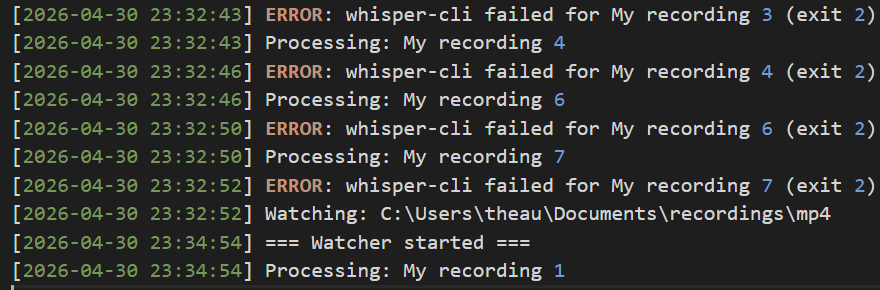
- You can see all the errors previously - and there are a HEAP more before that, followed by the final “Processing: My recording 1” which has been like that for many minutes now (I think at least half an hour), indicating that the recording is currently being transcribed, and so the bug that was causing the many previous error messages has been fixed.
- However, I must say, this transcription is taking a damn long time! Probably to be expected though with using a “bigger” model (more parameters), and I wouldn’t normally mind, especially after learning that the transcription can be resumed after sleeping/waking the computer (and the fact that it just runs peacefully in the background), but it’s late and I want to go to bed but I can’t shut my laptop down without losing all the transcription so far, and I think since this is the first transcription, I’m just wary of whether it will work properly. But once I know it’s a reliable transcription process, I don’t mind if it takes a while.
- Anyway, next it might be good to add some kind of indicator of transcription status so I can guesstimate when it will be finished (because rn, I feel like I’m just hovering around indefinitely waiting for it to complete, with no idea when this currently mythical completion will occur).
- I’m realising how addictive it is to develop these things, and for some reason, I always seem to have to get properly stuck into the development late at night. Like, if it’s not >midnight, you ain’t doin it right. Except, you (any entity that is not up creating an e.g. automated transcription thing) actually are (doin it right), because you won’t be tired tomorrow, while I will… 🙂↕️
- A note on the purpose of all this talkthrough of my mindware creation attempts
- These are not supposed to be entirely comprehensive or reproducible accounts of the mindware things I’ve done/created. They’re just to give a gist/overview of my approach, thoughts while doing it, learnings, problems encountered, etc.
- A core purpose of sharing these kind of thoughts is to contribute to the demonstration of evolution of thought and “under the hood” thought processes when e.g. doing novel and/or technical stuff, to see how TM (this mind) approaches things, which gives an insight into (1) how this particular mind does these things and (2) how minds do these things in general (and showing the workings of my mind is like one data point/vector toward this).
- mindware
- Would be good for each chunk of raw thought substance to have e.g. ID to enable easy embedding/referencing within other thoughts and ability to e.g. demonstrate seeding/propagation/continuation (to show that that particular chunk of thought substance became the seed for a later chunk of thought), to better trace thought origins and evolutions.
- imagine
- I wanted to make this “imagine” note to store general ramblings/thoughts about what could exist (“could” meaning both what could exist in future, or what could currently exist but we’re not yet aware of).
- Actually, I might crystallise that distinction between the two types of “could” into some kind of micro taxonomy:
- (1) future-could refers to the “could exist” that means something could exist in the future.
- (2) current-could refers to the “could exist” that means something could already exist, but we’re not yet aware of it.
- There is probably overlap between these categories (e.g. a particular technology may currently exist elsewhere in an extraterrestrial civilisation (2), and then could exist here in Earthling civilisation in the future, if we happen to also develop it (1)).
- It’s my current primary place of not-necessarily-but-maybe reality exploration and word/world play and general fictionalising and creative exercise.
- An example of a thing that may belong in imagine that uses both future-could and current-could projections/postulations/imaginings:
- So… I flew for the first time as a human today. I sense I did it before in the many previous lifetimes in Tu’s origin node, which is why TM would so regularly dream of flight, free-fall, fluid-floating and complete movement autonomy.
- This particular flight mechanism/experience was materialised via a lightweight fusion-powered “jet pack” basically, a mini tank of water plus a pre-compressed/collapsed energy seed that periodically sprouts/spurts based on when the operating mind (in this case, TM) expresses desire to accelerate (or maintain velocity if falling) in the form of concrete (but still internal) thought, the signal of which is received via neural interface.
- Prior to this, we used an AR (augmented reality) experience with e.g. aptly positioned fans and water sprays to emulate the rustling and whistling of wind through hair and face-breeze and sprays of ocean/lake/river/oasis water as you descend over, virtually hovering inches above the body of water, occasionally dipping limbs in.
- But now we have the real thing and it is transformative - externally and internally. For one, new (super cool) mode of transportation. For two, it gives a different kind of overview effect - obviously, more zoomed in, but also, feels more “zoomy” because you’re closer to the ground than when e.g. rocketing off to a satellite/planet. Gives a sense of empowerment that only the experience can capture - no other medium than the thing itself can convey the emotional states invoked.
- I wanted to make this “imagine” note to store general ramblings/thoughts about what could exist (“could” meaning both what could exist in future, or what could currently exist but we’re not yet aware of).
- linguistics
- I’m trialling using “TM” to mean “this mind” (referring to my own mind) and “TE” to mean “this entity” (referring to myself).
- Also going to trial “Tu” to mean “this u” where “u” is a conscious subset of U - i.e., a subject. Basically is referring to each subject (i.e. being) as a microcosm/fractal of the unification/union of everything in existence, trying to simultaneously acknowledge oneness/universality (integration) and separateness/individuality (differentiation).
- I’ll use them kind of interchangeably, based on vibe for now.
- my-worldview
- A subject is a conscious object - i.e., a being.
- A thought on the continuity of “I”: my source strand is persistent, as in, it persists through spacetime, because it has a permanent slot in trans-temporal existence (which is existence in general), which all “conscious” things that exist have.
- I say “conscious” in quotation marks to more explicitly indicate that I generally use the term tautologically - as in, I’ll say e.g. “conscious entities are entities with property X”, and at the same time, say/imply that “entities with the property X are conscious” - so, I use the term in/as its own definition. This is just because my (and general human) thoughts about consciousness are quite woolly and there’s something that feels imperceptible or inexplainable about the idea of consciousness. So yeah, my use of quotation marks is to try to show that I’m using the concept “at arms length” sts
- The purpose of this “my-worldview” object (and its note)
- The my-worldview object represents the set of all my personal views of existence (views of all objects I currently perceive/conceive of). And so on this site, in/around this “my-worldview” note, I’ll just record any thoughts relating to this. But actually, basically all of the thoughts I share in this stream (and anywhere) are part of this worldview - they stem from it, are a product of it, and constitute it.
- But the thoughts I explicitly label as part of “my worldview” are generally more my-mind-specific (as in, potentially more niche or where there’s less general agreement in the collective worldview (set of all minds’ worldviews)) and/or are very prominent/integral in my worldview at the time.
- Often, thoughts will just occur to me and then the reasoning behind them emerges later (laggy reasoning) - so, I might write stuff which makes sense to me while writing, but I can only properly explain/decode/translate to other worldviews after thinking more about it / unpacking the words that flowed from the intuiting process. intuition-reason
- I will also say things as though they’re obvious or a given or have already been defined (e.g. using “the intuiting process” above as though it’s some established concept). This is generally because the thing is in fact established in my worldview, though I might not have explained it anywhere in any of my outputs (like this site), but probably will get round to it eventually.
- But primarily, this note is for maximal divergence and fully exploring and expanding my worldview in terms of my own worldview - so, I’m using relatively divergent conceptual/mindal terrain in order to diverge/veer into even more divergent terrain. So, it may get quite not-immediately-understandable / difficult to process for many minds, and that’s something that minds (including mine) need to accept in order to allow the full divergence which is necessary for full convergence and hence full progress.
- sts tags
- mean “so to speak”, as I tend to say a lot of things to which it would make sense to append a “so to speak” to (and obvs, want to eliminate that repetition where possible).
Wed 29-04-2026
- mindware
- Integrating conversations with LLMs into thought streams / general outputs
- When doing the exploration of web search in AI below, I realised how handy it would be to easily integrate chats with any LLM in a standardised format in a way that I can e.g. display or reference them in this stream, with the ability to very clearly indicate/highlight prompts and responses - maybe somehow hide/expand the LLM responses so it doesn’t clutter the stream and so inputters don’t get it mixed up with TM’s thoughts.
- I want to experiment with the best way to do this with current mindware, but also want to try to develop mindware to do this with my personal specifications/desired functionality in mind. Need to think more about best approach for now.
- Integrating conversations with LLMs into thought streams / general outputs
- my-mindware
- This tag/note is for thoughts around my own implementations/experiments with mindware and enhancing my own approach to expressing and formatting/organising thoughts.
- Anyway, I am happy because today I started using the Easy Voice Recorder app on my phone while commuting / doing general activities and have set up Syncthing to automatically sync the recordings onto my laptop, and I’ve set up Whisper on my laptop to transcribe the recordings. As of 23:10, transcribed one of the recordings like 3 times (takes a few mins each time) but I keep re-doing it because it hasn’t been saving anywhere so I’ve been troubleshooting to figure out how to actually save the generated transcript. Hopefully the transcription running now is going to save.
- Also, I just realised - I am such a numpty sometimes: I’ve been running the transcription on this super long ~20 minute audio (the first thing I recorded) when of course it would be far more efficient to test the transcription on a very short audio file first duyh 🤦♀️
- 23:15 - OMG it worked! Aaahhh I am so happy with that. Next, I’ll turn my attention to automating the process so that recordings on e.g. phone are automatically converted from mp4 to wav (as I think the whisper model I’m using only works with wav), then transcribed and the transcriptions appear in a Transcriptions folder on my laptop (so I don’t have to manually convert mp4 to wav, run the whisper model, etc.) - but that is a job for tomorrow.
- semiotics
- I am excited! [^incorrect] After discovering wp this word object which represents a field object ? (which I recall encountering previously but it never properly integrated into my worldview), because it seems to capture a large aspect interthinking acc.
- I encountered “semiotics” because I was looking into the difference between “symbolisation” and “signification” because I wanted to use one of them to start a note related to the use of tags such as acc, to explore how we can use symbols/signifiers to represent things or condense thoughts that appear often (which are generally meta-thoughts).
- And then I just realised that semiotics contains/subsumes both ? so I went with that.
- Wait! Actually, I realised for my purposes in what thoughts I’m trying to express, the term/field linguistics is probably more suitable. So I’ll go with that (by which, I mean “linguistics” will probably make frequent appearances in these outputs/ramblings, as it’s something quite prominent in my worldview acc).
- lingo tags
- used to explicitly indicate/highlight instances of strange (as generally collectively perceived) grammar/word usage, just to show that I acknowledge these instances won’t always be the easiest things to process.
- Again, this is all experimental so I’m just playing around with using various tags ad hoc / creating them whenever I feel like it, and time/usage will tell which will stick.
- wp tags
- means “word play” - used to explicitly highlight where I’m playing around with words/terminology to “test it”/feel it out and see what fits/works.
- Envelopment/enclosure of word-salads in ? question marks ? to explicitly label/denote epistemic uncertainty within the thought represented by the word salad and/or the choice of words in the salad. Yes, I’ll experiment with this.
- However, I project/predict/suspect that the inclusion of a prepended question mark (rather than the appended one) may introduce some friction in expression, so I’ll play around with using either 2 (opening & closing) or just the 1.
- thought-streaming
- (which acc could be considered a subset of the general collective-intelligence)
- Grammatical incorrectness - intention(al)? lingo
- Sometimes! I just feel like expressing a thought (saying something) in a less conventional / conventionally grammatically incorrect way (like the incorrect sentence-starting here where I’ve treated this new sentence as a continuation of the previous exclamation). I do this kind of thing quite frequently. And this serves a purpose of experimenting with different communicative approaches and diverging in these approaches so that we can continuously converge on better approaches and enhance/develop our ability to communicate effectively.
- But if I were to attempt more “official” writing like an academic essay/paper, report, etc. then I would just stick to more currently convergent (i.e. standard) approaches.
- acc tags
- Right now, I’m using this tag to mean “as currently conceived” to indicate that I acknowledge that whatever thought(s) the tag is around are only a current conception of the object they reference, and subject to change (and probably will change) so should not be taken as permanently representative of my worldview or any views within it.
Tue 28-04-2026
- self-management
- opportunity-cost - a concept that has been emerging as incredibly salient for me lately. It’s becoming the basis upon which I make all decisions in life, moment to moment - “smaller” (e.g. what song to listen to, or whether to listen to music at all as opposed to something else like audiobook/podcast) or “larger” (e.g. whether to go to an event or participate in a project).
- I’ve found it to majorly help with “cutting the crap” and “getting to the point” of general things in life. For example, where previously I would force myself to read a particular book because I thought it was a good book to read, I now allow myself to evaluate whether it is the best book (or thing) I could be inputting/processing at that time - and often, there are other things which are more directly relevant and would provide me with a greater magnitude and number (i.e. volume) of worldview upgrades - i.e. the gradient of understanding of things related to the-objective (= amount understood of relevant things / time spent trying to understand it) is greater.
- I also find I spend less time deliberating what to do, because I see the cost of thinking about doing stuff instead of actually doing stuff.
- Idek if I like the term “management” in self-management - alternatives? explore
- The Objective
- I’ll elaborate on what I mean by “The Objective” for the first time (on this site at least) here.
- The Objective has both personal and transpersonal meanings/interpretations:
- Personal: It refers to my personal objective in life, which is a culmination/integration/synthesis of all sub-objectives I may have at a given time, and aligns with a broader, general “purpose” in life, pertaining to my life’s work - what I wish to dedicate the majority of my conscious efforts in life towards.
- Transpersonal: It refers to a general objective of the collective (including all Earthlings, which obvs includes humans, and I also like to extend it to extraterrestrial entities) - an objective which I would boil down to “continually pursuing the full freedom and flourishing of all”, but I’ll elaborate on that later when I can be bothered.
- Anyway, my personal /subjective objective aligns with / is equivalent to my view of what the collective objective is - I also wish to pursue the full freedom and flourishing of all (which includes moi).
- I like to use “The Objective” to refer to literally everything I find interesting/important in life, and so if something is not relevant to / helpful in pursuing the* Objective, I ignore it / delete it from my conscious attention (my context window in LLM-speak, I guess).
- *also, sometimes I capitalise “The” and other times I don’t, based on vibe.
- neb tags
- I wanted to use this tag in a discussion below but thought I should elaborate on what I intend it to mean/represent first. It’s short for nebula, and is supposed to represent thought (substance) that is highly underdeveloped - just a tiny seedling of an idea, or some general basic thoughts (not yet matured into opinion/belief territory). In fact, the tag could’ve equally reasonably been e.g. seedling or compost perhaps, although I’m trialling neb and I’ll see which if any of these tags emerge as a dominant indicator for this kind of underdeveloped thought.
- collective-intelligence - continuous surveying / data capture
- neb I had a data science lecture today on hypothesis testing (specifically, a 2 sample t-test applied to investigating whether there are any positive/negative effects to limiting social media use) and during it, em the idea of continuous recording of relevant data by/for everyone who wants to be a node on the network that represents the Human Mind (will elaborate on this at some point). Then, instead of these on-off surveys which have a very low turnout / number of respondents, we could have access to long-term, frequently/continuously updated data on literally anything we find important / want to report, of which we can capture a subset (relevant to the thing we want to investigate) as a snapshot in time, giving far more data (from far more people, over far more possible metrics/measures) which is far “fresher” - basically, more representative of population.
Mon 27-04-2026
- collective-intelligence
- my-inputs Just been reading this article: The DAO and the Dao – Finding a Path to Govern the World - WFM/IGP
- It covers Decentralised Autonomous Organisations, an object (i.e., thing that exists) I enc a few years ago and completely forgot about the existence of until encountering it again recently. It feels salient/relevant/exciting for enhancing CI, so definitely something I want to explore further.
- Anyway, this particular article talks about the benefits of DAOs as a means of coordinating global efforts and forming a federated global governmental system. I like the idea of forming “Centralised Implementation Organisations” (CIOs): “if necessary for effective achievement of larger goals, they [people] can vote to create or fund a central entity to conduct certain tasks for them.”
- So, we can have the benefits of both distributed/decentralised and concentrated/centralised governing architecture.
- I also like how the article mentioned the connection of this use of DAOs to “Dao” (from Chinese philosophy, according to the article - something I’d like to explore more) as a kind of em overarching natural governing force (?)
- my-inputs Just been reading this article: The DAO and the Dao – Finding a Path to Govern the World - WFM/IGP
- IPO
- Interchangeability of the terms “input” and “output”
- For example, in the discussion about input selection from Sun 26-04-2026, I have used the term “input” to refer to outputs which I would end up inputting.
- Ultimately, all outputs are potential inputs. All inputs are/were (started as, originally) outputs.
- expand
- Interchangeability of the terms “input” and “output”
Sun 26-04-2026
- input-process-output
- input selection
- It would be good to be able to design our own inputs, as e.g. a synthesis of inputs we’d like to process, but condensed/compressed (so less time required to input, but inputting similar data).
- For example, I was listening to a podcast episode on Spotify that I’d stumbled across after searching something like “distributed systems” (https://open.spotify.com/episode/1sceyNTHqqVwifU67R7wJn?si=8290623bc973459e) and as I was listening, I got the impression that the episode was probably AI-generated (no offence to the creators if this is not the case) for reasons I can’t be bothered to unpack right now, and it made me think, actually, since the intersection of my interests forms a niche which is difficult to identify outputs directly related to (due to partial or complete lack of existence), maybe I could gather a bunch of outputs in my niche interest(s) and ask GenAI to integrate them into an e.g. podcast episode to input…
- At the same time, there are so many amazing, detailed, illuminating outputs (of which many are podcast episodes) that already cover a substantial subset of the set of things I’m interested in, so I don’t want to be wasteful in the content I choose to consume (or not consume).
- However, as I said, I’m not yet aware of many outputs that exist at the precise intersection of all my interests, and I think, in terms of both efficiency (less time, more data exposure) and effectiveness (exposure to more directly relevant, pre-synthesised data), it may be a good idea to dedicate at least a portion of my input time/energy to custom, “homemade” inputs (where I choose outputs from others I would like to combine into inputs for myself).
- Origin of thoughts
- At this moment in human post-evolution (? explore), we seem particularly preoccupied with tracing the origin of thoughts in terms of “giving credit where it’s due”, in the form of e.g. citations/references in academia, or “name-dropping” in general conversation minds/individuals we believe ideas emerged from. In some cases, this referencing (wherever it is along the formal-informal communicative spectrum) is non-egoic/self-transcendent in that its purpose is solely (or at least primarily) to provide context around the thought/idea we are talking about, in mentioning its (believed) thinker/originator (for example, it can be useful to understand in what historical or personal context a particular thought emerged). However, in many cases, this referencing is exactly the opposite, serving our ego in a kind of intellectual virtue signalling of demonstrating the extent of our knowledge for the sake of appearing knowledgeable. Often, this serves an important purpose of increasing our credibility (by e.g. appealing to the credibility of the individuals we are referencing, or by showing a general expertise to reassure inputters we know what we’re talking about), and this is important (right now*) for “being taken seriously” when interthinking/communicating. In this way, referencing origins/individuals can be both (1) egoic and (2) non-egoic: (1) in acting to increase credibility of / respect toward self, but (2) in doing this for the broader goal of reaching more minds more effectively.
- *I say “right now” because perhaps in future we can transition to an era/approach to interthinking where more weight is assigned to raw thoughts themselves, independent of thinker. But at this time, the cultivation of credibility as a thinker is generally necessary for minimising bias when others input your thoughts.
- But the point I intended to make before launching into this ramble is that, when we feel a need to store information about thought origins (e.g. individuals we encountered the thoughts from) in order to acknowledge their (lack of) originality, it creates a bogged-down-ness in our thinking - at least, this is how I feel; when I encounter a thought I find really important/useful and want to remember, and I’m overly preoccupied with remembering where/when/why the thought emerged (i.e., which mind outputted it originally (as far as I’m aware)), I find it harder to remember the important thought itself. So, it always feels like a waste of mental energy/exertion to try to recall who said what - I’d rather just recall the “what”, so that I have more space for more “whats”, rather than “who said whats”.
- And I feel this approach to inputting, processing and outputting thoughts (e.g. I hear/see mind X output thought Y, and I remember and process Y, and later output Y in a slightly altered form) should be acceptable, because I’m not making any claim of thought originality.
- This is a reason I think it’s valuable to categorise thoughts as emergent or encountered em-enc.
- input selection
Sat 25-04-2026
- Hello. This is strange. I’m not used to publicly thought streaming. I guess it’ll take a while to figure out who to address thoughts to. Some indeterminate observer(s) - individual, or collective? Myself? God/U? We’ll see.